
Artificial green wall on a building facade: what to check before you buy
In short
Before an artificial green wall goes on a facade, check eight things: fire-retardant foliage with a test report; UV-stabilised foliage for outdoor sun; fixings sized for the wind at that height; anchors into the structure, not the cladding; every anchor sealed so the waterproofing stays intact; galvanised and stainless parts kept apart so they do not corrode each other; a plan for reaching the wall to install and clean it; and full-size samples on the wall before the order.
The eight checks
| Check | What to ask for | Why it matters |
|---|---|---|
| Fire | Fire-retardant foliage, with the supplier's test report | Facades and public spaces need materials that stop burning once the flame is taken away |
| Sun | UV-stabilised foliage rated for outdoor use | Indoor-grade foliage fades and turns brittle quickly in Indian sun |
| Wind | Mesh, brackets and anchors sized for the wind at that height | Wind load rises with height and exposure |
| Anchors | Anchors into concrete or masonry, not cladding, pull-tested on site | The wall hangs on them for years |
| Waterproofing | Every anchor sealed, in a detail you can show your consultant | A leaking anchor costs more than the wall |
| Metals | Isolation washers between galvanised and stainless parts | Dissimilar metals corrode each other in coastal air |
| Access | A plan to install and clean: BMU, scaffolding or ladders | A wall you cannot reach cannot be kept clean |
| Samples | Full-size sample panels on the wall before the order | Colour and density look different at full size and from the street |
Fire comes first
Ask for fire-retardant foliage and the supplier's test report, and share it with your fire consultant early. On a facade or in a public interior it is the first thing an approving authority or a client's safety team asks about.
Fire-retardant foliage is treated so it does not keep burning once the flame is taken away. Keep it clean all the same: dry leaves and litter caught in the foliage add fuel.
Sun and wind decide the materials
Outdoors, use UV-stabilised foliage; indoor-grade foliage fades and turns brittle quickly in Indian sun. Even UV-stabilised foliage fades slowly over the years, so plan to replace sections, not the whole wall.
Higher up, the wind is stronger. Size the mesh, brackets and anchors for the wind at that height and exposure, and tie or clip the foliage so it cannot lift off.
Fix to the structure and protect the waterproofing
Anchor into concrete or masonry, not into cladding or plaster, and pull-test the anchors on site. Every anchor is a hole in the building's skin, so each one should be sealed, in a detail your facade or waterproofing consultant has seen.
Where galvanised and stainless steel meet, isolation washers keep them apart; in coastal air, dissimilar metals that touch corrode each other.
Plan the access before the order
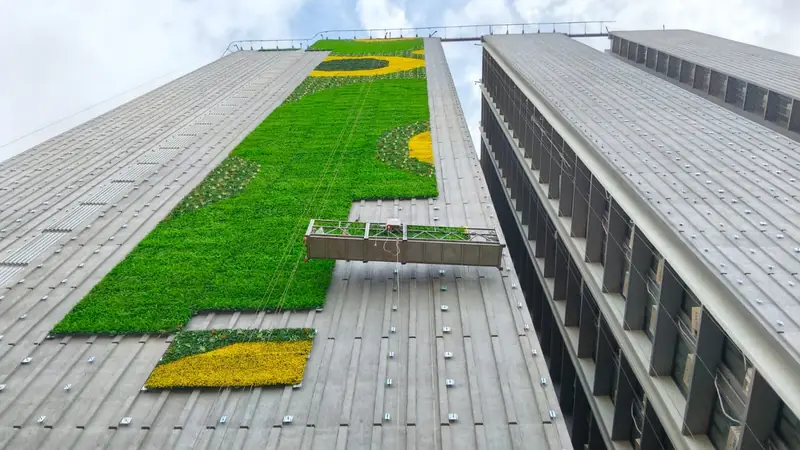
Decide how crews will reach every part of the wall, to install it and later to clean it: the building's BMU, scaffolding or ladders. On a tall facade the BMU usually sets the order and the pace of the work.
At Prestige 101, BKC, our crews installed five walls, each about 79 m high, from the BMU while the site was still under construction.
Approve it on the wall
Ask for full-size sample panels fixed on the actual wall. Colour, density and pattern look different at full size and from the street than on a 300 mm sample.
Agree the cleaning schedule and who does it at the same time. An artificial wall needs no water or pruning, but it does need cleaning.
Questions
How long does an artificial green wall last outdoors?
It depends on the sun, the dust and the grade of foliage. UV-stabilised foliage holds its colour far longer than indoor-grade foliage, and a wall fixed in sections lets you replace faded parts without taking it all down.
Does an artificial green wall add load to the facade?
Some: the foliage, mesh and brackets. It is far lighter than a living wall, which carries wet growing medium and water. Your structural engineer checks the anchors and the load.
Can an artificial green wall be removed later?
Yes, if it is mechanically fixed: tiles, mesh and brackets come down in sections and can be reused. Put it in the brief, as it shapes the fixing detail.
Who approves the fixing detail?
Your structural engineer and your facade or waterproofing consultant. We share the detail, the anchor data and the pull-out test results.