
Green wall, green facade or green roof: which one do you need?
In short
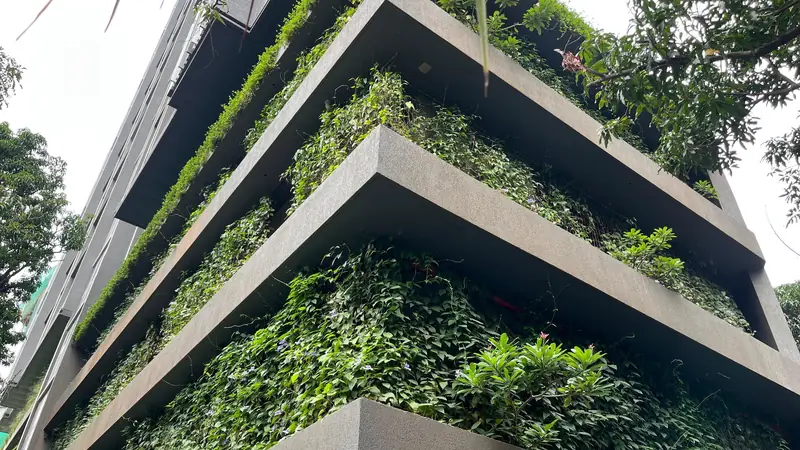
A green wall (also called a living wall or vertical garden) holds plants in panels fixed to a wall, with drip irrigation built in, and is green from day one. A green facade grows climbing plants from planters up a stainless net or trellis held in front of a building face; it is lighter and economical over large areas, but fills in over growing seasons. A green roof lays plants in a growing medium over drainage and root-barrier layers on a waterproofed roof, terrace or podium, and always starts with a structural check.
Side by side
| Green wall | Green facade | Green roof | |
|---|---|---|---|
| Surface | Interior or exterior walls | Building faces, podium edges, boundary walls | Roofs, terraces and podiums |
| How plants grow | Rooted in panels or modules on the wall | Climbers rooted in planters or the ground, trained onto a net | In a lightweight growing medium over a drainage layer |
| Green at handover | Yes, fully planted | Partly; cover builds over growing seasons | Yes; fills in over the first months |
| Load on the structure | Panels, wet growing medium and plants, spread over the wall | Light: nets, ropes and planters at the base or on ledges | Highest: roughly 60–150 kg/m² for thin roofs to 300 kg/m² and more for deep ones, when saturated |
| Water | Drip lines in the panels on an automatic controller | Drip at the planters | Drip or sprinklers; drainage cells hold some water back |
| Care | Regular: pruning, replacements, irrigation checks | Seasonal: training growth onto the net, pruning | Seasonal for thin roofs, regular gardening for deep ones |
| Plan it with | Fit-out and MEP teams: water, drain, power, light | Structural engineer and facade consultant | Structural engineer and waterproofing contractor |
| Best for | Lobbies, cafeterias, meeting rooms, feature walls | Large building faces, car-park structures, podium edges | Terraces, podium gardens, cooling the floor below |
Start with the surface you have
A vertical surface indoors points to a green wall: a living wall if there is light and a water point, artificial foliage or preserved moss if there is not.
A vertical surface outdoors can take an outdoor living wall or a green facade. A horizontal surface over a structure, such as a roof, a terrace or a podium over a basement, points to a green roof.
When a green wall is the better choice
When the space must look finished on opening day, when the area is close to people (receptions, cafeterias, meeting rooms) and when you want a dense planted surface with varied colour and texture.
Indoors, plan four things early with the fit-out team: light (daylight or grow lights), a water point, a drain and power for the irrigation controller.
When a green facade is the better choice
When the face is large, such as several floors or a long boundary wall, and cost per square metre matters: climbers grow into the area instead of being planted across it. Also when the structure cannot take the weight of living panels.
The trade-off is time. Cover builds over growing seasons; pre-grown climbers, planter ledges or a band of living panels give an earlier green look.
When a green roof is the better choice
When there is a flat surface over a structure: a terrace that heats the floor below, a podium over a car park, or a roof that people could use.
A planted roof shades the waterproofing from sun and heat, slows rainwater run-off and can count toward heat-island (roof) credits in green-building ratings such as IGBC and LEED. A structural engineer confirms the load before design, and the waterproofing is tested before planting.
Can they be combined?
Often that gives the best result. A podium can carry a roof garden with planter ledges and climbers on its edge. On the cable-net facade we are building for Fairfield by S Raheja in Mumbai, climbers planted on four podium floors will grow up a 12-metre band of stainless net.
Questions
Is a vertical garden the same as a green wall?
Yes. Green wall, living wall and vertical garden all mean plants grown on a vertical surface. Living wall usually means real plants with built-in irrigation, as against artificial foliage or preserved moss.
What is the difference between a green facade and a living wall?
A green facade uses climbing plants rooted at the base or on ledges, growing on a net or trellis in front of the wall. A living wall holds the plants and their growing medium in panels on the wall itself.
Which costs less over a large area?
For large building faces, climbers on a stainless net usually cost less per square metre of green than living panels, because the plants grow into the area. Living panels cost more but are green at handover.
Do green roofs cause leaks?
A properly built green roof protects the waterproofing. The membrane is tested before planting, a root barrier keeps roots away from it, and drainage cells carry water to the outlets.